

Is Palm Oil Worse Than Animal Agriculture
A fiddling over a month agone, Republic of indonesia's Environs and Forestry Ministry building sought to extend a moratorium on issuing new licenses for using forest and peatland in the country for 2 years.
Republic of indonesia faces a massive ecological issue as its forests are rapidly disappearing and palm oil has been blamed for it. Indeed, the palm oil industry symbolises tensions between the urgent demand to preserve natural spaces and the necessary support for economical development in the global South.
Palm is an infrequent oleaginous crop with an unequalled oil yield per hectare. It produces an abundant and inexpensive multi-purpose oil, which is sought by both the agro-food and biofuels industries.
When properly developed and managed, palm oil plantations can play an important function in improving livelihoods and eradicating poverty in the tropics' rural areas. The Earth Banking company estimates that with a population increase of eleven.half-dozen% and a v% increase in per capita consumption, an additional 28 million tonnes of vegetable oils will have to exist produced annually by 2020.
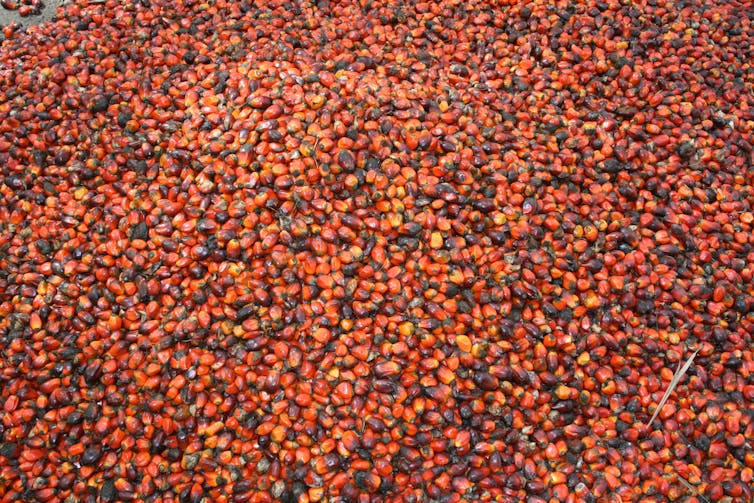
Global production of palm oil is now dominated past Indonesia and Malaysia, which together business relationship for 85% of the globe's supply. Consumption is driven by emerging economies, such as India, Indonesia and China, in which both population growth and ascension living standards are key factors for the rising demand. European consumption accounts for xv% of global palm oil use, while the US uses iii%.
The deforestation question
The European Parliament resolution of four April 2017 on palm oil and deforestation concluded a debate on the possibility of controlling palm oil imports with the specific aim of limiting deforestation in Southeast Asia.
The issue was addressed in an article published by the French newspaper Le Monde on April 3 2017. Dealing with environmental damage related to palm oil production, the commodity claimed:
The conversion of land to oil palm plantations alone is responsible for xl% of the loss of natural woods embrace around the globe.
But exploring the source of this data shows that palm oil is actually responsible for only 2.3% of the world's deforestation. How tin this discrepancy exist explained?
Questioning numbers
The Le Monde commodity is based on a March 2017 report by the European Parliament on the social and environmental impacts of oil palm cultivation. Our team has advisedly examined this 400-page paper, from which the twoscore% figure most probably originates.
Information technology says that 40% of global deforestation is due to the shift to large-scale oil palm monoculture plantations and that 73% of the world'southward deforestation results from land clearance carried out for the product of agricultural raw materials.
These are the same deforestation figures for world agronomics and for the oil palm sector, just this time taking into account all forms of agriculture, non just "intensive" or "industrial" agriculture.
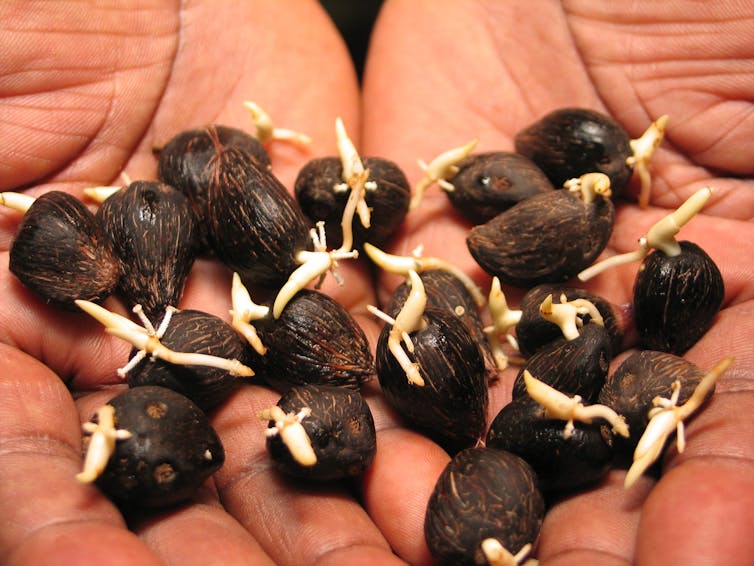
Information technology is worth noting that smallholder farmers play a cardinal role in global agronomical production: 95% of coffee, cocoa and rice production comes from them. In the palm oil sector, non-agro-industrial farms account for near 40% of the area and these likewise contribute to deforestation.
The information published in the European Parliament's written report are non all referenced. If the 73% figure is not connected to a source, the forty% figure is cited as originating from a 2013 technical report that follows a written report commissioned by the European Commission, carried out past 3 individual consultants.
Information technology states that 239 million hectares of forests were cut down during the studied menstruum, mostly in the tropics or subtropics: 91 meg hectares in Latin America; 73 one thousand thousand in sub-Saharan Africa; 44 million in Southeast Asia.
Agriculture is therefore the leading cause of global deforestation, with 24% of the land used for livestock and 29% for crops. The written report provides some details of the 29% chunk of deforestation due to agricultural crops, highlighting the crops with the highest contributions – soybean (19%), maize (eleven%), oil palm (8% %), rice (6%) and sugarcane (5%).
Allow's recalculate
According to these data sets, palm oil plantations account for only 8% of the deforestation attributed to agricultural crops. In total, this represents 8% of 29%, thus two.iii% or 5.6 million hectares from the 239 1000000 hectares of forest lost between 1990 and 2008.
In order to notice the forty% figure, we must expect a little further in the technical study to where deforestation in Brazil and Indonesia is analysed. These are the two countries in which forest losses were reported to be the highest.
In just Indonesia, 25 million hectares of forest were lost, of which 7.5 million hectares were used for agronomical production. Of these 7.5 million hectares, 2.9 meg represent to oil palm plantations, about twoscore%. It is therefore responsible for twoscore% of deforestation – but only that caused past the agricultural sector and only in this 1 land, not the world.
Why we need better information
Our business is that distorted data is able to directly shape public opinion. Reports such equally the one past the European Parliament now guide public priorities in terms of regulation and policies, which is even more worrying.
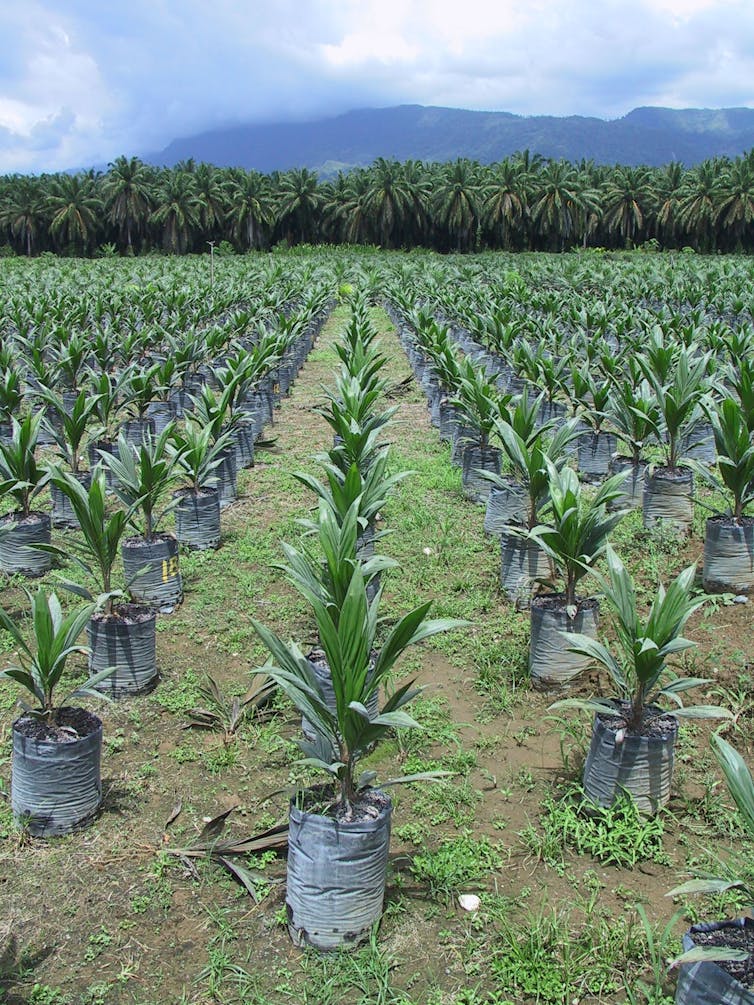
The publication of the European Parliament study immediately provoked potent reactions from Indonesia and Malaysia, which denounced discriminatory and protectionist measures and announced economic retaliation on imports from Europe that includes wheat to airplanes.
Faced with producing countries that will defend palm oil production at any toll – as it is regarded equally a major vector for economic development and rural poverty eradication - the European union must build a solid argument before designing policies that take all the established causes of deforestation into account.
What the latest studies say
As far as Indonesia is concerned, there are several published scientific studies with more than up-to-date data than the technical report commissioned by the European Commission. One of these, published in Nature Climate Change, shows evidence that the loss of main forests connected to accelerate in Republic of indonesia (specially on Sumatra and Borneo islands) between 2000 and 2012 equally rates jumped from 200,000 to 800,000 hectares a yr.
Aimed at deciphering the causes of deforestation, another report roofing the catamenia 2000 to 2010 highlights the industries responsible for deforestation in Indonesia: tree plantations for pulp (12.8%), forestry concessions (12.5%), industrial oil palm plantations (11%) and mining concessions (2.1%).
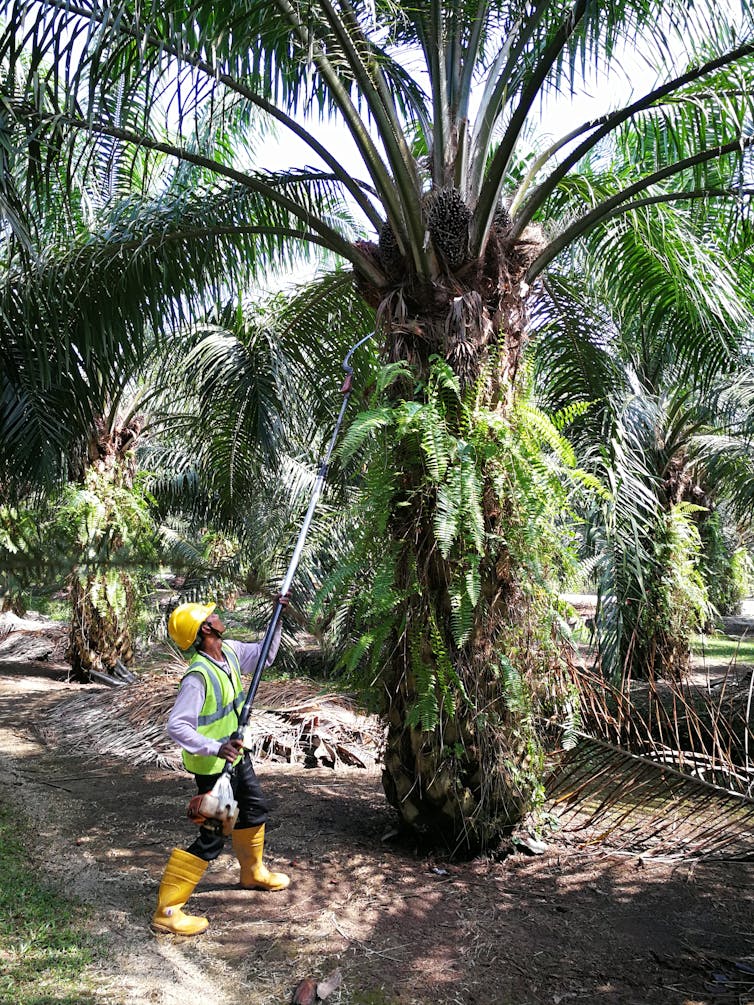
The share attributable to palm oil was greater on the island of Borneo. Indeed, the most recent review study on the topic monitored forest losses over the past twoscore years and institute that, today, 7 million hectares of industrial plantations (for palm oil and pulp) are located in areas that were covered past master forests in 1973.
This study stresses that links between industrial plantations and deforestation are not e'er direct. Only 25% of the deforestation occurring in Borneo corresponds to a straight conversion into plantations.
In other cases, forests are exploited for timber – either legally or illegally – and this weakens and exposes natural spaces to frequent fires. Deforested areas are not immediately or automatically regrown, and as a outcome, Indonesia alone harbours more than fifty million hectares of degraded forest land.
The way forward
Sustainable solutions call for articulation actions in and with producing countries. Agro-industrial palm oil plantations accept a real responsibility for deforestation although this is shared with other sectors of the Indonesian economy, such as lurid and paper, forestry and mining.
The increase in the frequency of uncontrolled fires is also a major cause of the degradation of forests in Sumatra and Kalimantan. An official from the Borneo Futures NGO interviewed in September 2015 past the Dki jakarta Globe, argued that the fight against woods fires remains ineffective because it does non consider the true causes.
Local communities and small farmers are the source of the bulk of fires because they do not accept the aforementioned means as agro-industries to get access to the state.
Defining credible and effective public policies for sustainable rural development involves diverse groups of stakeholders with often divergent interests. Information technology requires both scientists and policy makers to work with accurate data, understood in the right context and taken from verifiable sources.
Source: https://theconversation.com/no-palm-oil-is-not-responsible-for-40-of-global-deforestation-78482
Posted by: najerafortionle.blogspot.com
0 Response to "Is Palm Oil Worse Than Animal Agriculture"
Post a Comment